
Steel-Faced Concrete Curb NYC
A plain-English guide to steel-faced concrete curbs in NYC. What they are, where the City requires them, and how they compare to plain concrete and granite, so you know exactly which curb belongs in front of your property.
Based on NYC DOT Guidelines
Written by Curb Specialists





What Is a Steel-Faced Concrete Curb?
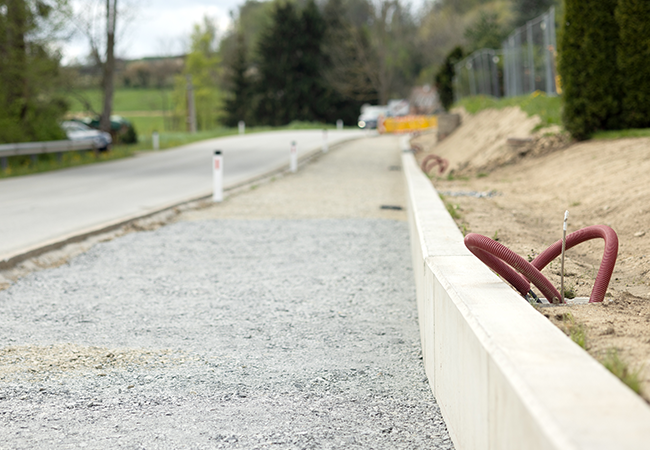
A steel-faced concrete curb is a concrete curb with a steel plate covering its exposed street-side face. The steel is anchored into the concrete when the curb is poured, so the two work as a single piece. It’s often called a metal curb or steel curb, and it’s the standard curb in much of New York City. NYC’s Street Design Manual describes steel facing as added protection for cast-in-place concrete curbs, typically used where vehicle traffic is heavy, such as along bus and truck routes, and commonly in very flat areas where drainage is a challenge.
Steel Plate Face
A steel plate covers the exposed face of the curb, where tires, plows, and bumpers make contact.
Anchored Into Concrete
Anchors on the back of the plate lock it into the concrete, so the facing can't work loose under normal traffic.
Poured as One Curb
The steel is set to line and grade first, then the concrete is poured behind it, forming one solid curb.
Where NYC Requires Steel-Faced Curbs
In New York City, curb type isn’t a design preference. NYC DOT’s sidewalk and curb design guidelines set it by zoning district, and one rule applies on every corner in the city.
Commercial Districts
Properties in C (commercial) zoning districts require steel-faced concrete curbs.
Manufacturing Districts
Properties in M (manufacturing) zoning districts require steel-faced concrete curbs.
R-7 and Higher-Density Residential
Residential districts zoned R-7 and above require steel-faced curbs. Plain concrete is permitted only in R-1 through R-6.
Every Corner, Every District
Corner curbs need steel facing everywhere in the city, including R-1 through R-6 blocks where the rest of the curb can be plain concrete.
What NYC Property Owners Say About Our Steel Curb Work
We needed a stronger curb solution for an area that gets frequent vehicle traffic. The steel-faced concrete curb came out solid, straight, and much more durable than the old curb.
Steel-Faced vs Plain Concrete vs Granite Curbs in NYC
NYC uses three main curb types, and each one has its place. Steel-faced concrete is the workhorse for busy streets, commercial and industrial areas, and every corner. Plain concrete is allowed on lower-density residential blocks, away from corners. Granite is the traditional stone curb, still found on many older streets.
Granite follows its own rules. Under DOT’s guidelines, existing granite curbs are generally replaced in kind, and all new curbs in designated or pending landmark districts must be granite. If your property has granite today, or sits in a landmark district, a steel-faced curb usually isn’t the right replacement.
Steel-Faced Concrete
Required in C, M, and R-7+ districts and at all corners. The most impact-resistant choice.
Plain Concrete
Permitted only in R-1 through R-6 districts, and never at corners.
Granite
Replaced in kind where it exists, and required for new curbs in landmark districts.
Not Sure Which Applies?
We check the zoning and existing curb at your address before we quote.
Steel-Faced Curb Work Across NYC and Westchester
We install, repair, and replace steel-faced concrete curbs throughout four NYC boroughs and Westchester County.
The zoning rules on this page apply within New York City. In Westchester, curb requirements are set by each city, town, or village, and we follow the local standard on every job there.
Steel-Faced Concrete Curb Projects in NYC
Steel-Faced Concrete Curb FAQs
How do I find out what curb my NYC property needs?
Start with your zoning district. You can look up any address on ZoLa, the NYC Department of City Planning’s zoning map, to see whether it’s in a C, M, or R district. Then check whether the curb is at a corner and whether there’s existing granite. Those three answers usually tell you the curb type, and we confirm it for free during a site visit.
Can I choose steel facing even if plain concrete is allowed?
Generally yes, where the zoning permits plain concrete, steel facing is a common upgrade for curbs that take regular impact from trucks, buses, or plows. The main exceptions are existing granite curbs and landmark districts, where granite is the rule.
How long does a steel-faced concrete curb last?
Much longer than plain concrete where traffic is heavy, because the steel absorbs the impacts that would otherwise chip the concrete. How long a specific curb lasts depends on how well the steel was anchored, how water drains at the curb, and exposure to road salt. Keeping joints sealed and fixing loose facing early are the two biggest ways to extend its life.
What goes wrong with steel-faced curbs over time?
The most common problems are facing that loosens or lifts, steel bent by vehicle impact, rust along the bottom of the plate, and concrete breaking down behind loose steel. Most of these can be repaired if caught early. See our metal curb repair page for what’s involved, or metal curb replacement when the curb has failed.
Metal Curb Services in NYC
Now that you know which curb you need, here’s how we can help.